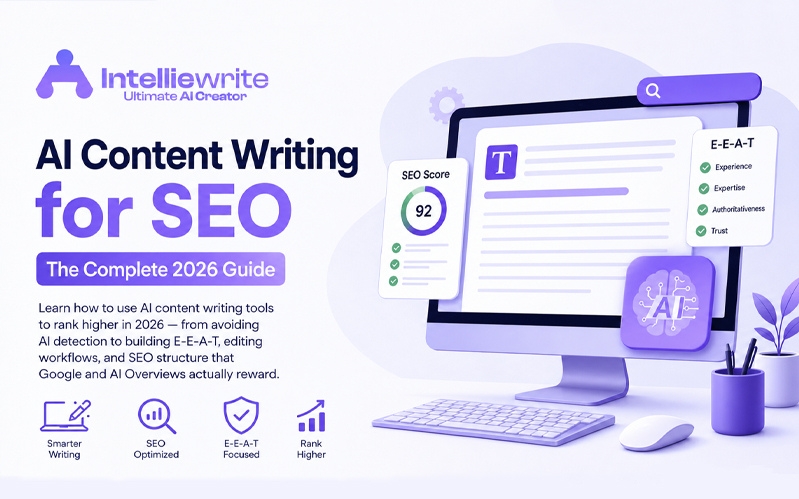

AI Content Generator Best Practices for SEO (2026)

AI Content Generator Best Practices for High Quality SEO Content
Creating content fast is easy today. But creating content that actually ranks? That is still a challenge.
Many businesses use AI tools to save time. They publish raw drafts without any changes. These articles often sound robotic and generic. They fail to build trust with readers and rarely perform well in search results. You should not use AI to do all the work. Instead, use it to scale your own unique expertise.
The following steps will show you how to move past the ‘generate-and-publish’ trap. You will learn how to optimise for E-E-A-T and use Intelliewrite to build a content engine that truly resonates.
What Is an AI Content Generator?
An AI content generator is a tool that helps create written content from prompts, topics, outlines, or instructions.
It can help with:
- landing pages
- product descriptions
- emails
- social media captions
Good tools do more than write text. They help you organise ideas, save time, and speed up content creation.
Still, AI should not do all the work. You need to review the draft, fix errors, and make sure it matches your brand voice.
Why AI Content Generation Needs Human Oversight
AI can save time. However, it cannot think like a real person.
Many AI-written articles fail because they sound flat. They repeat common points and offer nothing new.
Human editing makes content stronger because it helps you:
- Add real experience
- Check facts and claims
- Match your brand tone
- Remove generic wording
- Answer the reader’s real question
That is why you should never publish raw AI content without reviewing it first.
Real-World Experience With AI Content Generation
In our experience, AI content generators like Intelliewrite can significantly speed up the drafting process, helping teams move from idea to first draft much faster. However, the real value comes after generation. When human editors refine the content, add practical insights, and align it with user intent, the overall quality improves noticeably. This approach ensures the content is not only fast to produce but also useful, accurate, and trustworthy for readers.
How to Use AI Without Hurting SEO
Google does not reject content simply because AI was used in its creation. What truly matters is the quality of the content.
If the content is helpful, original, and made for people, it can perform well. But if it is made only to manipulate rankings, it can hurt your SEO.
So instead of using a “generate and publish” method, use a smarter process.
1. Start with search intent: Solve the user's problem first
First, understand what the reader wants. Are they trying to learn something? Compare tools? Solve a problem? Your content should clearly answer one main intent.
2. Build an outline before prompting
AI gives better results when your structure is clear. Before you generate content, define:
- the target audience
- the tone
- the main headings
- the questions the content should answer
This procedure keeps the article focused.
3. Add human insight
AI drafts often sound polished, but they can feel empty. So add real examples, useful advice, and practical tips. It makes the article more helpful and more original.
4. Edit for originality
Do not leave the content full of filler.
Remove repeated ideas. Replace vague lines with specific points. Add your own point of view where it makes sense.
5. Check basic SEO elements
Before publishing, review the important SEO basics:
- clear title
- strong headings
- useful meta description
- natural keyword use
- internal links
- mobile-friendly layout
These small details still matter.
What Makes the Best AI Content Generator?
Many people look for the best AI content generator by focusing only on speed. But speed alone is not enough. A strong tool should help you create better content, not just faster content.
Look for a platform that supports:
How does content planning improve AI SEO?
It should help you with topic ideas, content clusters, and outlines.
Better workflow
It should reduce repetitive tasks and help your team work faster.
SEO support
It should help you create better headings, titles, and keyword placement without stuffing.
Brand consistency
It should make it easier to keep the same tone and message across all content.
Ease of use
It should fit your workflow and not force you into stiff, robotic templates.
Some tools only generate text. Others, like Intelliewrite, support a bigger content process that includes planning, optimisation, and brand communication.
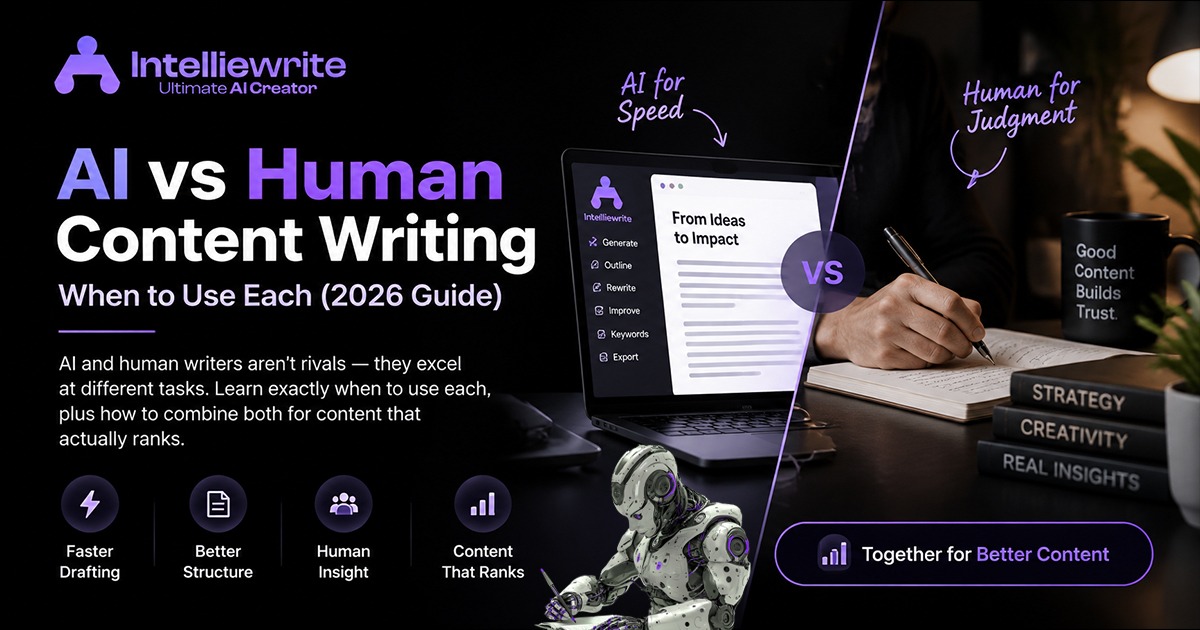
AI Content vs Human Content: What Works Best?
AI content and human content both have strengths, but the best results come from combining them. It helps with speed, idea generation, and drafting, while human writers add expertise, originality, and brand understanding.
Relying only on AI can lead to generic content, while fully manual writing can slow down production. A balanced approach ensures faster output without compromising quality, trust, or SEO performance.
AI Content vs Human Content at a Glance
Best Practices for Publishing High-Trust AI Content
If you want better rankings and stronger engagement, follow these rules:
Be clear about who created the content
Show the author, editor, or team behind the article when possible. It builds trust and clarifies the source.
Be honest about how it was made
If AI helped with drafting or research, be transparent when needed.
Add something original
Do not publish content that says the same thing as every other article.
Add examples, lessons, workflows, or tips from your own experience.
Avoid fake claims
Do not use made-up stats, fake case studies, or unsupported promises. These hurt trust.
Use FAQs only when they help
Do not add FAQs just to make the page longer.
Only include them if they answer real questions the reader may still have.
Keep the whole page focused.
Your title, introduction, headings, and ending should all support the same topic. It makes the article stronger and more relevant.
A Smarter Content Workflow With Intelliewrite
The best way to use Intelliewrite is to treat it like a writing assistant, not a full replacement for your team. A simple workflow looks like this:
- Choose the topic and audience
- Create an outline based on user intent
- Generate the first draft
- Add human insights and examples
- Edit for clarity, tone, and SEO
- Publish with proper metadata and links
- Update the content when needed
This way gives you the speed of AI and the quality of human editing.
Common Mistakes to Avoid
Many AI-assisted blog posts fail because they make the same mistakes.
Avoid things like:
- Repeating the keyword too much
- Writing weak introductions
- Using generic headings
- Publishing without trust signals
- Adding fake stats
- Ignoring updates
- Making the page hard to read on mobile
If your blog feels like it was written only for rankings, readers will notice. Search engines may notice too.
Final Thoughts
An AI content generator can be very useful. But it works best when it supports a thoughtful content process.
AI can help you move faster. Still, quality comes from planning, editing, and adding real value.
If your brand wants to scale content without losing trust, tools like Intelliewrite can help. Just remember this: the first draft is only the start. What matters most is how you improve it after that.
FAQs
1. Is AI content allowed by Google?
Yes. Google allows AI content if it is useful, original, and written for people.
2. Can AI content rank on Google?
Yes. But it should be edited, checked, and made helpful for readers.
3. How can I make AI content unique?
Add real examples, simple insights, and your own brand voice.
4. What is the best way to use AI for SEO content?
Use AI for drafting, then improve the content with human editing.