Global Content Strategy With Intelliewrite: How to Use AI to Write in Multiple Languages?
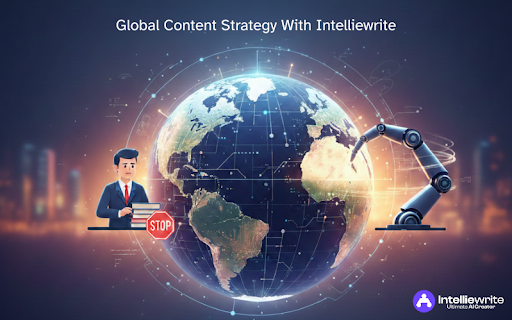
Reach the world—faster than ever. Expanding your content globally isn't just an option anymore; it's essential for growth. Connecting with multilingual audiences can skyrocket your business, but manual translation is slow, expensive, and often inconsistent.
With AI-powered tools like Intelliewrite, you can craft multilingual, SEO-ready content in minutes, keeping your brand voice sharp and consistent across every market. Turn one piece of content into a worldwide presence without the usual hassle.
Why Global Content Strategy Matters
A global content strategy helps your business reach international audiences effectively.
- Increase search visibility: Localized content ranks higher in local search engines.
- Engage diverse audiences: Communicate in their language and tone.
- Boost conversions: Relevant, localized content drives action.
- Save time and costs: AI streamlines content creation across languages.
Example: A SaaS company that publishes blogs in English, Spanish, and French can double website traffic within a few months by leveraging AI-assisted localization.
The Problem With Traditional Translation
Traditional translation often fails because it focuses on word-for-word conversion.
Key Issues:
- Loss of brand tone: Literal translation sounds unnatural.
- Cultural mismatch: Idioms and examples may not resonate.
- SEO inefficiency: Keywords may not translate effectively.
- Slow turnaround: Manual translation delays content publishing.
How AI Solves Multilingual Content Challenges
AI offers more than translation. It generates content that is culturally relevant, SEO-optimized, and brand-aligned.
Benefits of Using AI:
- Context-aware language generation: Adapts tone and phrasing.
- SEO-ready content: Includes localized keywords automatically.
- Brand consistency: Maintains your messaging across languages.
- Speed and scalability: Produce multiple language versions in minutes.
AI vs Traditional Translation
Step-by-Step: Multilingual SEO With Intelliewrite
Follow these steps to implement a global content strategy efficiently.
Step 1: Identify Target Markets
- Research countries where your audience exists.
- Examine local search behavior.
- Prioritize markets with heightened potential.
Step 2: Perform Local Keyword Research
- Find keywords specific to each language.
- Consider search intent and local variations.
- Use semantic keywords to improve SEO performance.
Step 3: Generate Base Content
- Write the main content in your primary language.
- Structure headings, meta descriptions, and CTAs.
Step 4: Use AI to Localize Content
- Translate while adapting tone and examples.
- Ensure content is culturally suitable.
- Optimize CTAs for each region.
Step 5: Optimize for International SEO
- Add hreflang tags for search engines.
- Regionalize URLs and metadata for SEO.
- Adjust internal linking for different languages.
Step 6: Scale With AI Templates
- Keep brand messaging consistent globally.
- Automate repetitive content workflows.
Real-World Use Cases
E-Commerce
For e-commerce businesses, multilingual SEO
helps present products globally. Intelliewrite can
generate product descriptions in multiple
Languages and create ad messaging that
resonates locally while maintaining consistent
branding.
Agencies
Agencies can manage multilingual client content with ease.
AI enables them to scale content production without additional
manual effort, delivering high-quality, market-specific
content faster.
Video & Podcasts
Video and podcast creators can generate scripts
in multiple languages and pair them with AI
voiceovers. Audio content can also be turned
into SEO-friendly blog posts to reach a wider
international audience.
Tips for Effective Multilingual Content
- Focus on intent, not just translation. Users should feel the content was written for them.
- Use AI to enhance, not substitute. Human reviews ensure accuracy and brand alignment.
- Maintain constant formatting across languages.
- Track performance for each market to optimize continuously.
Common Mistakes to Avoid
- Directly translating content word-for-word.
- Ignoring cultural context.
- Use consistent keywords for all regions.
- Skipping native proofreading.
How Intelliewrite Supports Multilingual SEO
It makes scaling global content simple:
- Supports 54+ languages.
- Maintains consistent brand tone.
- Offers SEO templates and automated workflows.
- Generates AI voiceovers and text-to-speech in multiple languages.
- Converts audio content to blog posts for different markets.
By combining these features, teams can publish content faster, rank higher, and engage more users globally.
FAQs
What is a multilingual content strategy?
It's a plan to create, localize, and optimize content for global audiences.
It's a plan to create, localize, and optimize content for global audiences.
How does AI help with multilingual SEO?
AI generates localized, keyword-optimized content quickly while maintaining tone and brand voice.
AI generates localized, keyword-optimized content quickly while maintaining tone and brand voice.
How can I write content using AI?
Use AI by providing a topic or outline, and it automatically generates SEO-friendly, well-structured content.
Can AI replace human translation entirely?
AI speeds up localization, but human review ensures accuracy and cultural relevance.
AI speeds up localization, but human review ensures accuracy and cultural relevance.
What is the best workflow for global content?
Identify markets → Keyword research → Base content → AI localization → SEO optimization → Scale with templates.
Identify markets → Keyword research → Base content → AI localization → SEO optimization → Scale with templates.
Which languages does Intelliewrite support?
This AI tool supports 54+ languages, including regional dialects and voice options.
This AI tool supports 54+ languages, including regional dialects and voice options.
Final Thoughts
Scaling content globally no longer requires manual translation. With AI tools like Intelliewrite, businesses can quickly and consistently produce SEO-ready, localized content.
Start using AI to expand your reach, engage diverse audiences, and grow internationally. Don't let language barriers limit your growth—leverage Intelliewrite to scale globally today.