
AI Content Writing for SEO: The Complete 2026 Guide
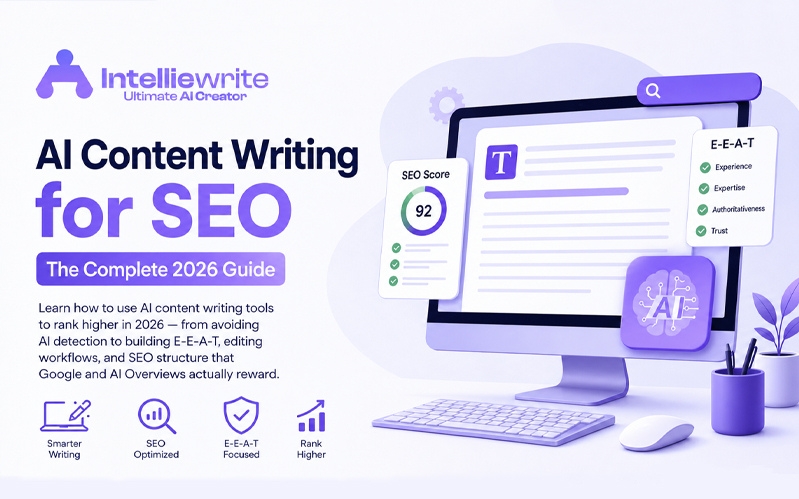
AI Content Writing for SEO: The Complete 2026 Guide
AI writing tools promise to make content creation faster. What most brands discovered instead is that speed alone doesn't rank. In 2026, Google's ranking systems and AI Overviews are both tuned to reward content that demonstrates real expertise, original insight, and a human editorial hand — and to quietly filter out content that reads like a template with the nouns swapped out.
This guide covers what actually works: how to use AI as a writing accelerator without producing the kind of generic, interchangeable content search engines are actively de-prioritizing, how to structure content for both traditional search and AI-powered answer engines, and how to build the trust signals that separate ranking content from ignored content.
Why "AI-Written" and "Low-Ranking" Aren't the Same Thing
There's a persistent myth that Google penalizes AI-generated content outright. It doesn't. Google's own guidance has been consistent: it ranks content based on quality and usefulness, regardless of how it was produced. What actually gets filtered out is content that is:
- Generic — it could apply to any brand, in any voice, with the names swapped
- Structurally shallow — it summarizes a topic without adding a new angle, data point, or firsthand experience
- Editorially untouched — no fact-checking, no brand voice, no correction of AI's tendency to hedge and pad
The problem isn't the tool. It's using the tool as a finish line instead of a first draft.
The Real Difference Between AI and Human Content Writing
Framing this as "AI vs. human" is the wrong lens. The content that ranks in 2026 is almost always a blend: AI handles structure, drafting speed, and keyword coverage; a human editor supplies the specificity AI can't invent — actual product experience, real customer outcomes, and judgment calls about what to cut.
A useful test before publishing: could a competitor swap their brand name into this post without changing a single sentence? If yes, it's not ready to publish. If the post references something only your team could know — a workflow you use, a mistake you've seen clients make, a specific number from your own data — it has a much better shot at both ranking and being cited in AI Overviews, which pull disproportionately from sources that state something concrete rather than something general.
How to Avoid AI Content Detection Issues (and Why That's the Wrong Goal)
Search teams increasingly ask "how do I avoid AI detection?" It's the wrong question. Detection tools are unreliable, and Google doesn't rank based on them. The right question is: does this content sound like it was written by someone who has actually done the thing it's describing?
Practical fixes that address the underlying issue (not just the symptom):
- Cut the hedge-and-summarize pattern. AI drafts often open sections with a restated version of the heading ("Understanding X is important because..."). Delete these. Start with the point.
- Replace generic examples with specific ones. "Many businesses struggle with X" becomes "A SaaS client of ours cut onboarding time from 12 minutes to 4 by doing X."
- Vary sentence rhythm. AI drafts tend toward uniform sentence length. A human edit breaks that pattern naturally.
- Remove uncommitted language. Words like "can," "may," and "could" stacked across a paragraph signal a draft that hasn't been fact-checked into a firm claim yet.
- Add at least one thing only you know. A number, a screenshot, a named example, a contrarian opinion — something a generic prompt couldn't produce.
Building E-E-A-T Into AI-Assisted Content
Experience, Expertise, Authoritativeness, and Trust are the framework Google's quality raters use, and they matter more — not less — as more content is AI-assisted, because they're the signals that are hardest to fake at scale.
For AI-assisted content specifically, prioritize:
- Named, credentialed authors. A byline with a real name, a linked author bio, and a sentence on why this person is qualified to write on the topic outperforms an anonymous or generic byline.
- Firsthand experience markers. Phrases like "when we tested this," "in our data," or "a pattern we've seen across clients" signal the Experience pillar specifically — the one most AI-only content can't produce.
- Original supporting data. Even a small internal survey, a before/after metric, or a screenshot of your own tool in use adds a layer competitors copying generic content can't replicate.
- Structured trust markers. Author schema, organization schema, and a visible editorial or fact-checking note all support the Trust pillar technically as well as editorially.
An Editing Checklist for AI-Generated Drafts
Use this before anything AI-assisted gets published:
- Does the intro make a specific point in the first two sentences, or does it summarize the topic generically?
- Is there at least one example, data point, or detail that couldn't have come from a generic prompt?
- Are headings structured as questions or specific claims (better for AI Overview extraction) rather than vague labels?
- Has every statistic or claim been verified against a real source?
- Does the author byline link to a real bio with credentials?
- Have hedge words and repeated sentence structures been edited out?
- Is there a clear, non-generic connection to your product or service — not just a tacked-on CTA?
- Does the post link to and from related content on your site (not just an auto-generated widget)?

Structuring AI Content for Both Google and AI Overviews
The content that shows up in AI Overviews and traditional rankings shares a structural pattern: clear question-based subheadings, a direct answer in the first sentence after each heading, and a dedicated FAQ section using the exact phrasing people search for. This isn't a trick — it's the same clarity that makes content useful to a human skimming a page, which is exactly why extraction systems favor it.
Practical structure:
- Lead each section with the answer, then explain the reasoning
- Use H2s and H3s that mirror real search queries, not internal jargon
- Keep an FAQ section near the end targeting the specific long-tail questions your audience types into search
- Avoid stacking multiple ideas into a single paragraph — one clear idea per block is easier for both readers and extraction systems to lift out
Choosing the Right AI Writing Tool for SEO Work
Not all AI writing tools are built for the same job. When evaluating one for SEO content specifically, the meaningful differences are:
- Whether it supports structured, editable outlines (not just one-shot generation)
- Whether it can maintain a consistent brand voice across a large volume of content
- Whether it integrates keyword and SERP research into the drafting process, rather than requiring a separate tool
- Whether output is genuinely editable and modular, versus a monolithic block of text that's hard to restructure post-generation
The goal isn't finding a tool that writes a "finished" article — no such tool exists, no matter what the landing page says. The goal is finding one that gets a strong first draft done fast, so more of your time goes into the editing work above, which is where the ranking difference actually comes from.
Frequently Asked Questions
Does Google penalize AI-generated content?
No. Google has repeatedly clarified that it ranks content based on quality and usefulness, regardless of whether it was written by AI, a human, or both. What gets filtered out is low-quality content — generic, unoriginal, or unhelpful — which can be produced by either.
How much editing does AI content need before publishing?
Enough to add at least one specific, firsthand detail per major section, remove repetitive AI phrasing patterns, and verify every factual claim. A good baseline is treating the AI output as a first draft that needs a genuine editorial pass, not a final copy that needs a light proofread.
Can AI content rank in AI Overviews and SGE results?
Yes, but it competes on the same basis as any other content: clear structure, direct answers, and specific, verifiable information. Content that's vague or overly hedged is less likely to be extracted, regardless of how it was produced.
What's the biggest mistake brands make with AI content and SEO?
Publishing AI output with minimal editing across a large volume of pages. This produces a pattern of thin, interchangeable content across a domain, which can suppress rankings site-wide, not just on individual pages.
Is AI content detection something I need to worry about for SEO?
Not directly — search engines don't use AI-detection scores as a ranking signal. The underlying issues those detectors flag (genericness, hedging, lack of specificity) are the real problem, and fixing those improves both detectability concerns and actual ranking performance.