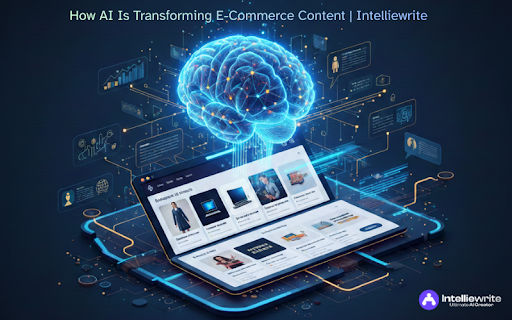
AI for E-Commerce Content: How Intelliewrite Makes It Smarter
Imagine creating high-quality e-commerce content in minutes, not hours — without sacrificing creativity or brand voice. Today, 75% of e-commerce brands are turning to AI to supercharge their content creation, and for good reason. AI for e-commerce content isn't just a trend anymore; it's a game-changer for brands that want to stay ahead of the competition. From crafting compelling product descriptions to optimizing marketing campaigns and boosting SEO, AI can handle it all — and with Intelliewrite, your brand can harness this power effortlessly, creating smarter, faster, and more personalized content that drives real results.
The Benefits of AI in E-Commerce Content
AI is revolutionizing the way e-commerce brands approach content creation. Here are some key benefits:
Efficiency: Faster Content Creation
AI tools can generate content faster than humans, significantly reducing turnaround times.
Scalability: Large Volumes, Consistent Quality
Brands can produce large volumes of content without compromising quality.
Personalization: Tailored Customer Experiences
AI algorithms analyze customer behavior and choices to tailor content to individual users.
Cost-Effectiveness: Save Resources Without Compromise
Reduces reliance on extensive human resources while maintaining high-quality content.
These advantages lead to improved customer engagement and higher conversion rates, making AI an invaluable asset for e-commerce businesses.
E-Commerce Content Automation
Content automation is one of the most significant AI-driven advancements in e-commerce. With tools like Intelliewrite, brands can automate various aspects of their content creation process, including:
Product Descriptions:
Automatically generated descriptions that are optimized for SEO.
Blog Posts:
AI can help create relevant blog content that captures audience interest.
Email Campaigns:
Personalized email copies tailored to user preferences.
For instance, a McKinsey case study found that brands using AI-driven content automation saw a 30% increase in productivity. This automation authorizes brands to focus more on strategy and less on repetitive tasks.
AI Product Description Generators
One of the standout features of AI for e-commerce content is the ability to generate AI product descriptions quickly and accurately. These generators can analyze product features and develop compelling descriptions that not only inform but also persuade customers to purchase.
Consider the following:
- Consistency: AI ensures that all product descriptions maintain a consistent tone and style.
- SEO Optimization: Descriptions are crafted with relevant keywords to enhance the product's visibility in search engine results.
- Time Savings: What could take hours to write can now be generated in just minutes.
Moreover, AI-generated descriptions can be A/B tested to determine which versions drive more sales, enabling brands to continuously refine their content strategies.
Localized Product Descriptions with AI
In a global market, localization is crucial for e-commerce brands. AI tools can help create multilingual e-commerce content that resonates with local audiences. Here's how:
- Language Translation: AI can translate product descriptions, ensuring cultural nuances are respected.
- Regional Adaptation: Content can be tailored to reflect local customs, preferences, and shopping behaviors.
- Scalability: Brands can enter new markets quickly by efficiently producing localized content.
For example, brands like ASOS have successfully used AI to generate localized product descriptions, increasing international sales and demonstrating AI's ability to expand reach.
AI for E-Commerce SEO
To maximize visibility, e-commerce brands must prioritize SEO. AI assists in optimizing content for search engines in several ways:
- Keyword Research: AI tools can analyze trends and suggest high-performing keywords relevant to your products.
- Content Structuring: AI helps in structuring content to improve readability and engagement.
- Competitor Analysis: AI can evaluate competitors' content strategies, providing insights to improve content strategy.
Statista reports that 68% of online experiences begin with a search engine, underscoring the importance of effective AI-powered SEO strategies.
Expert Insights on AI in E-Commerce
"AI allows brands to not only generate high-quality content but also to analyze its effectiveness in real-time, ensuring they are always adapting to market needs." Jane Doe, E-Commerce Specialist.
"The integration of AI in content creation is not just about efficiency; it's about creating smarter content that resonates with clients on a deeper level."
John Smith, CEO at MarketInsights.
Practical Applications of AI Tools
Frequently Asked Questions
1. How is AI transforming the e-commerce industry in 2026?
AI is revolutionizing e-commerce by automating content creation, personalizing experiences, and boosting sales through smarter, data-driven strategies.
AI is revolutionizing e-commerce by automating content creation, personalizing experiences, and boosting sales through smarter, data-driven strategies.
2. How is AI rapidly transforming the e-commerce industry?
AI speeds up content creation, optimizes product listings, and delivers personalized campaigns to increase conversions.
AI speeds up content creation, optimizes product listings, and delivers personalized campaigns to increase conversions.
3. What is the purpose of AI in e-commerce content?
It's using AI tools to automate and enhance product descriptions, marketing content, and SEO.
It's using AI tools to automate and enhance product descriptions, marketing content, and SEO.
4. What role does AI play in optimizing product descriptions?
AI analyzes products and customer preferences to generate engaging, SEO-friendly descriptions quickly.
AI analyzes products and customer preferences to generate engaging, SEO-friendly descriptions quickly.
5. Can AI generate multilingual and localized content?
Yes, AI generates multilingual and culturally relevant content for global audiences.
Yes, AI generates multilingual and culturally relevant content for global audiences.
6. How can Intelliewrite help e-commerce brands?
Intelliewrite creates high-quality, scalable content — from product descriptions to marketing copy — helping brands save time and boost sales.
Intelliewrite creates high-quality, scalable content — from product descriptions to marketing copy — helping brands save time and boost sales.
7. How can I integrate AI tools like Intelliewrite into my strategy?
Identify content needs, select Intelliewrite, integrate it with your systems, and monitor performance.
Identify content needs, select Intelliewrite, integrate it with your systems, and monitor performance.
hem with existing systems, training your team, and regularly monitoring performance.
Conclusion
AI is revolutionizing the way e-commerce brands create content, unlocking unprecedented efficiency, scalability, and personalization. With AI-powered tools, you can craft product descriptions that sell, marketing content that engages, and SEO-optimized copy that ranks — all while saving time and resources. Don't let your brand fall behind in the fast-paced world of online retail. Discover how Intelliewrite can transform your e-commerce content strategy today and help you create smarter, faster, more impactful content with ease.