
AI vs Human Content Writing: When to Use Each (2026 Guide)
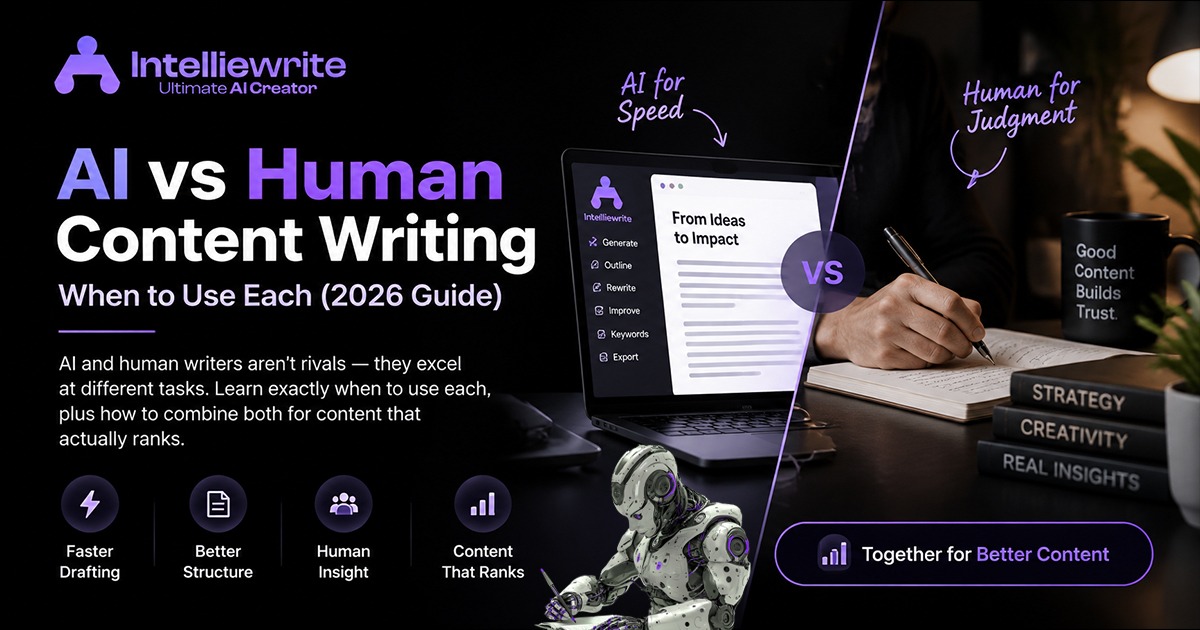
AI vs Human Content Writing: When to Use Each
The "AI vs. human" framing shows up in nearly every content strategy conversation now, and it's usually the wrong question. Google has been explicit that it ranks content on quality, not on how it was produced — so the more useful question is which parts of the content process each one actually does better. Treating this as a binary choice is how brands end up either publishing generic AI output at scale, or burning human hours on tasks a machine handles just as well.
This guide breaks the content process into its actual components and shows where AI adds speed, where a human is still doing work that can't be replicated, and how to combine the two — a workflow covered in more depth in our full guide to AI content writing for SEO.
What AI Is Genuinely Better At
Speed on structure and drafting. Turning a keyword and outline into a full first draft in minutes instead of hours is the single clearest AI advantage. This matters most for high-volume content — comparison pages, glossary entries, FAQ expansions — where the ceiling on quality per piece is lower and volume matters.
Consistency across large content sets. AI holds a formatting pattern or tone guideline more reliably across 50 articles than a rotating team of freelance writers will, assuming the prompting and brand voice guidelines are solid — this is the specific gap Intelliewrite's brand voice controls are built to close.
Keyword and structural coverage. AI is reliable at making sure a draft touches the subtopics and related terms a topic should cover, based on patterns across large amounts of existing content.
Repetitive, low-judgment writing tasks. Meta descriptions, alt text, product description variants, and other high-volume/low-differentiation writing are tasks where AI output, lightly reviewed, is often indistinguishable from a human first draft — because the task itself doesn't require much judgment.
What Humans Are Still Better At — and Why That's Not Changing Soon
Firsthand experience. AI can describe a process. It cannot have run that process, watched it fail, and know why. Any sentence that starts with "in our experience" or "a mistake we've seen" has to come from an actual human who did the thing.
Judgment about what to cut. AI drafts tend to include everything relevant. Good writing is disproportionately about deciding what doesn't need to be said. That editorial judgment — what a specific reader, at a specific point in their research, actually needs next — is a human skill, and it's a large part of what separates content that meets the bar in our E-E-A-T checklist for AI-generated content from content that doesn't.
Original opinions and contrarian takes. Content that ranks and gets shared often takes a position, not just a summary of the landscape. AI, by design, tends toward balanced, hedged framing. A human writer willing to say "most advice here is wrong, and here's why" produces something genuinely differentiated.
Reading the room on brand voice and audience nuance. AI can approximate a style guide. It can't reliably sense when a joke lands wrong for the audience, when a technical explanation needs simplifying for this specific reader, or when the tone of a competitor comparison is veering into something that'll read as defensive rather than confident.
Fact-checking and source verification. AI-generated statistics and claims need human verification before publishing, full stop. This isn't optional — unverified AI claims are one of the fastest ways to damage the trust signals both readers and Google's own quality rater guidelines look for under the E-E-A-T framework.

A Practical Split: Where Each Fits in the Workflow
When to Lean More Human
- Content on topics where your brand has genuine, hard-won expertise (this is where E-E-A-T and differentiation both live)
- High-stakes commercial pages — pricing, comparison, and product pages that directly influence buying decisions
- Anything where a factual error carries real risk (compliance, financial, medical-adjacent topics)
- Cornerstone/pillar content meant to be the definitive resource on a topic
When to Lean More AI
- High-volume, templated content (location pages, product variant descriptions, glossary entries)
- First-draft generation for topics where the outline and structure matter more than deep original insight
- Repurposing existing content into new formats (turning a webinar transcript into a blog post draft)
- Meta content, internal descriptions, and other low-visibility writing tasks
The Actual Answer
Neither AI nor human writing "wins." The content that ranks in 2026 is built on a workflow where AI removes the time cost of getting a structured first draft down, and a human spends that reclaimed time on the parts of writing that were always the hard part anyway — judgment, specificity, and genuine expertise. Brands that skip the human half publish content that reads like everyone else's. Brands that skip the AI half move too slowly to compete on volume where volume matters. For a full breakdown of the editing checklist that bridges the two, see the complete AI content writing for SEO guide.
Frequently Asked Questions
Is AI-only content ever good enough to publish as-is? For very low-stakes, high-volume content (basic meta descriptions, simple product variant text), lightly reviewed AI output can be sufficient. For anything a reader will spend real time on — blog posts, guides, comparison pages — it needs a human editorial pass to add specificity and verify accuracy.
Will AI writing tools eventually replace human writers for SEO content? For the drafting and structuring stage, AI has already largely taken over. For the judgment, specificity, and firsthand-experience components that search engines increasingly reward, there's no indication that's changing — those require actually having done or known something, not just pattern-matching existing text.
How do I know if my content is too AI-generic? Ask whether a direct competitor could swap their brand name into the piece without changing a sentence. If yes, it needs a human pass to add something only your brand or team could know.
What's a realistic time split between AI and human effort per article? It varies by content type, but a common pattern is AI handling roughly 60-70% of the raw word count generation (outline, first draft), with human editing time concentrated on the 20-30% of the piece that carries the specificity, examples, and judgment calls — which is disproportionately what determines whether it ranks.