The Future of Content Creation | What’s Next for AI in 2026–2027
Artificial intelligence isn’t slowing down—it’s accelerating.
From writing assistance to full-scale content production, AI is reshaping how creators, brands, and businesses bring ideas to life. And as we move into 2026–2027, we’re entering a new era where content won’t just be generated—it will be personalized, multimodal, real-time, and brand-aware.
Below is a look at the biggest AI trends set to redefine content creation—and how Intelliewrite is preparing creators for that future.
Hyper-Personalized Content Becomes the New Standard
The next evolution of content is personalization at scale.
Instead of generic articles, brands will deliver:
- Content tailored to each user’s interests
- Dynamic messaging based on browsing behavior
- Customized product recommendations
- Location-based content
- AI-generated variations for different audience segments
With future content tools, personalization will no longer be manual—it will be automated, precise, and deeply human-sounding.
What this means:
Your blog posts, ads, emails, and scripts won’t look the same to everyone.
They’ll adapt to each consumer as naturally as a conversation.
Your blog posts, ads, emails, and scripts won’t look the same to everyone.
They’ll adapt to each consumer as naturally as a conversation.
Multimodal AI Takes Over (Text + Image + Audio + Video)
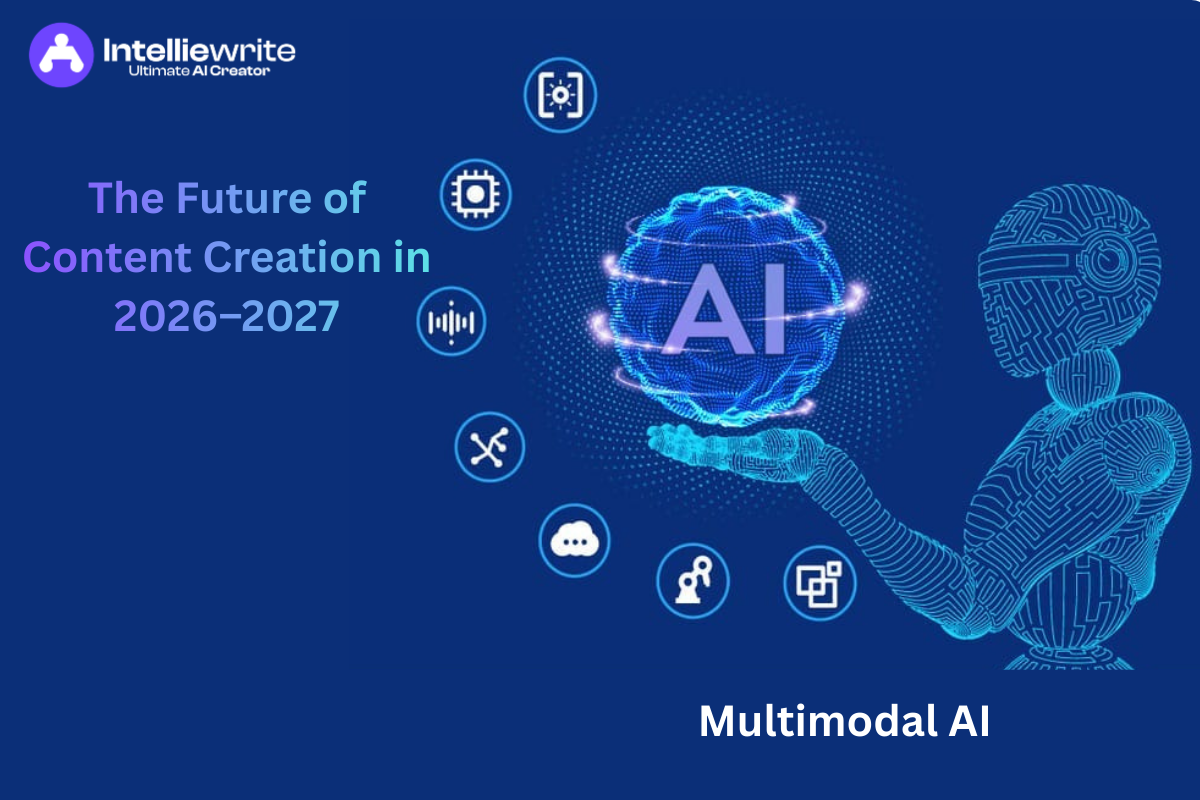
2026–2027 will be dominated by multimodal generative AI.
Meaning:
Your writing tool won’t stop at text. It will help you generate full content ecosystems.
Your writing tool won’t stop at text. It will help you generate full content ecosystems.
Multimodal AI will handle:
- Text → articles, scripts, captions
- Images → thumbnails, product photos, graphics
- Audio → podcasts, voiceovers, ads
- Video → short-form clips, animations, complete storyboards
The future of AI writing goes beyond words—it’s about end-to-end content production.
This will drastically reduce production time for:
- YouTubers
- Podcasters
- E-commerce brands
- Social media creators
- Agencies & marketing teams
Real-Time Content Generation Becomes the Norm
Search engines, social media, and consumers all reward speed.
In 2026 onward, AI will generate real-time:
- News summaries
- Trend-based content
- Product updates
- Market analysis
- Personalized responses
What used to take hours or days will be produced instantly.
Creators will be able to:
- Respond to trends as they happen
- Publish the same day
- Adjust campaigns on the fly
- Repair SEO gaps instantly
Real-time content will give small teams the power to compete with big agencies.
AI Editing Assistants Get Smarter
Today, AI editing is basic—grammar, tone, and clarity.
By 2027, editing AIs will:
Rewrite content based on audience intent
- Strengthen arguments & structure
- Fix SEO issues automatically
- Match brand voice with near-perfect accuracy
- Recommend improvements based on data
Instead of thinking like tools, they’ll think like senior editors.
Expect features like:
- Rewrite for higher retention
- Fix SEO cannibalization
- Reorganize for a more persuasive flow
- Make this more engaging for Gen Z
Editing becomes creative—not corrective.
Automated Brand Content Engines Are Coming
- Brand guidelines
- Tone of voice
- Target audience
- Previous content
- Product knowledge
AI will autonomously produce:
- Blog posts
- Emails
- Scripts
- Social media
- Product descriptions
- Landing pages
These engines will allow brands to scale content 10x faster with fewer resources.
AI won't replace content teams—it will empower them.
How Intelliewrite Fits Into the Future of AI Writing
Here’s how:
Built for Multimodal Content
Intelliewrite already supports long-form writing, scripts, social content, and more—setting the foundation for text → image → audio → video multi-output.
Hyper-Personalization on the Horizon
Future updates will make content feel customized for every audience segment, not generic.
Real-Time Content Production
Creators will be able to react instantly to trends, news, and algorithm changes.
AI Editing Assistant
Intelliewrite’s upcoming editor will analyze tone, structure, SEO, and clarity—offering human-level refinement.
A Unified Content Engine for All Creators
No switching between tools.
No juggling subscriptions.
Just one platform that handles it all.
No juggling subscriptions.
Just one platform that handles it all.
Intelliewrite is positioning itself not as a tool, but as a creative partner for the future.
Conclusion: The Future Belongs to Creators Who Adopt AI Early
Whether you write blogs, scripts, ads, or product descriptions, the future of content is clear:
AI won’t replace creators. It will amplify them.
Those who embrace AI early will outrank, out-create, and outperform the competition.
Those who embrace AI early will outrank, out-create, and outperform the competition.
And platforms like Intelliewrite are designed to carry creators confidently into 2026, 2027, and beyond.
The next wave of AI isn’t coming.
It’s already here—and this is your moment to ride it.
It’s already here—and this is your moment to ride it.